

14·
20 days agoI order a lot of takeout and recently stopped using online ordering because a bunch of them in the area stopped allowing orders as a guest. They force to log in or sign up. I’ve found that calling the store is easier and faster
I order a lot of takeout and recently stopped using online ordering because a bunch of them in the area stopped allowing orders as a guest. They force to log in or sign up. I’ve found that calling the store is easier and faster

By sheer coincidence, I just made an install image yesterday and will be switching soon

There’s some debate on this! Most movie dialogue is designed to convey the impression of conversation, but this is naturally unrealistic. People stutter and start over and get distracted in normal conversation much like you described, which can become very burdensome on the screen. Like when your boss won’t get to the point in the standup. Overly precise dialogue is equally burdensome and often fails to maintain attention (see: the Time 1776 AI videos). A lot of the discussion around how best to balance those natural pauses and disruptions around the otherwise “eloquent” speech in movies to best convey a characterization.
I’m sure others out there can point to legitimate sources, but I’m not super read up on it
Do my 600 applications mean nothing?!
(Yes, they in fact mean nothing)

If it doesn’t feature 4NonBlondes and What’s Going On, then I’m not interested

Well I just dumped windows and MS office. For machine vision I’m only dabbling with openCV, so that’s already open source. The switch to libre office has been pretty nice though
Pulse Water Modulation
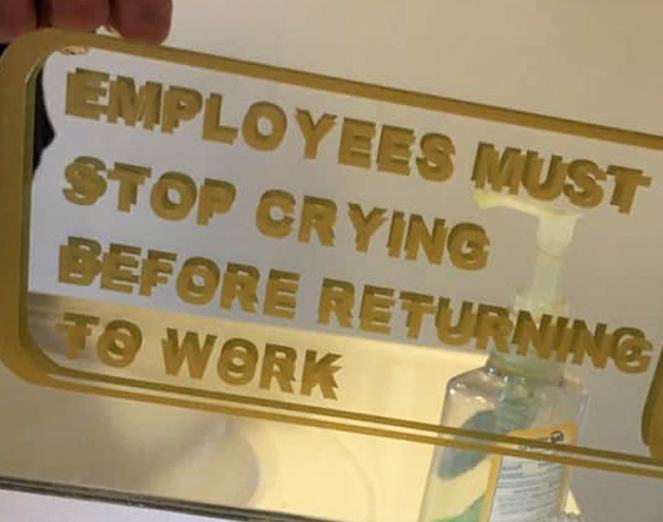
Commenting for some context.
I have some experience with this since I was a recruiter for a couple years (Disclaimer: before trump). I did officer recruiting and had no quota, so I had the freedom to be more honest with people. My first question was always, “Do you want to join the military?” And if the answer was “no” I’d tell them to go do anything else. If the answer was “yes,” I’d try to figure out what they really wanted. Often what they wanted was something they could find elsewhere and I would tell them so and how to get there. Occasionally someone would just be pro-military and I put a lot of energy into explaining that there are no promises, no guarantees, and the government will do what it wants with you whether you like it or not. My goal was to dismiss misconceptions (often generated by media/movies or recruiting ads themselves). This was before this insane trump era and I had fewer reservations if someone truly wanted it AND had the wherewithal to be a decent human about it.
Enlisted recruiters don’t necessarily have the same leeway. They are directly graded on the number of enlistments they get in whatever reporting period. Their promotions often depend on it. They are also given materials and information to use. The message above looks like a mixture of someone trying to meet their enlistment quota through outreach and a certain well-intentioned blindness that comes from years of indoctrination to trust the system. I’d be hesitant to say this recruiter is personally trying to round up immigrants, although there is always a chance. It seems more likely that this either came from higher in the organization, like Pentagon level directive (arguably more concerning), or comes from short-sighted intention to help without considering or being aware of the broader dangers so they’re trying to disseminate info about programs that could have been helpful in the past without understanding how they can also be weaponized.
That being said! Intention doesn’t matter. This is a program that can be weaponized and it should be ridiculed as such.
PSA: Everyone should always be highly skeptical when dealing with recruiters, now more than ever, especially since they are graded on number of enlistments. If anyone you know is considering an enlistment tell them that recruiters are not there to help you get what you want, they’re there to make numbers. The incentive structure for them is not in anyone else’s best interest. I’ve found this argument to be effective where more ideological arguments may not land or may further entrench.
Cool thanks, I’ll stick with it! At least until I’m familiar and want to try something new
No worries, it’s all part of the experience
Hmm, okay. Yeah I was trying to set up an environment to dabble with machine vision and had trouble finding good instructions or guidance for programming env setup. I think in college we used something-Unix but it’s been so long I don’t really have a frame of reference anymore. So I’m looking for a low-overhead daily driver that’s also relatively common or amenable to maker communities
If that makes sense.
Damnit I just switched to Ubuntu. That explains why I kept getting lost. What about Debian?

Ann Leckie is such a great author. I recommend the Radch to everyone who asks for a book

It’s almost a concept of a plan

It’s kind of a disingenuous comparison in the video, but I understand why he did it. The one that settles slowly has no dampening, either fluid or an inductive plate, because he set its initial position by hand. Can’t really do that if it’s in a fluid, although he could have compared in other ways, like setting the initial position with another magnet or comparing to another induction dampened compass and emphasizing that you can see through his.

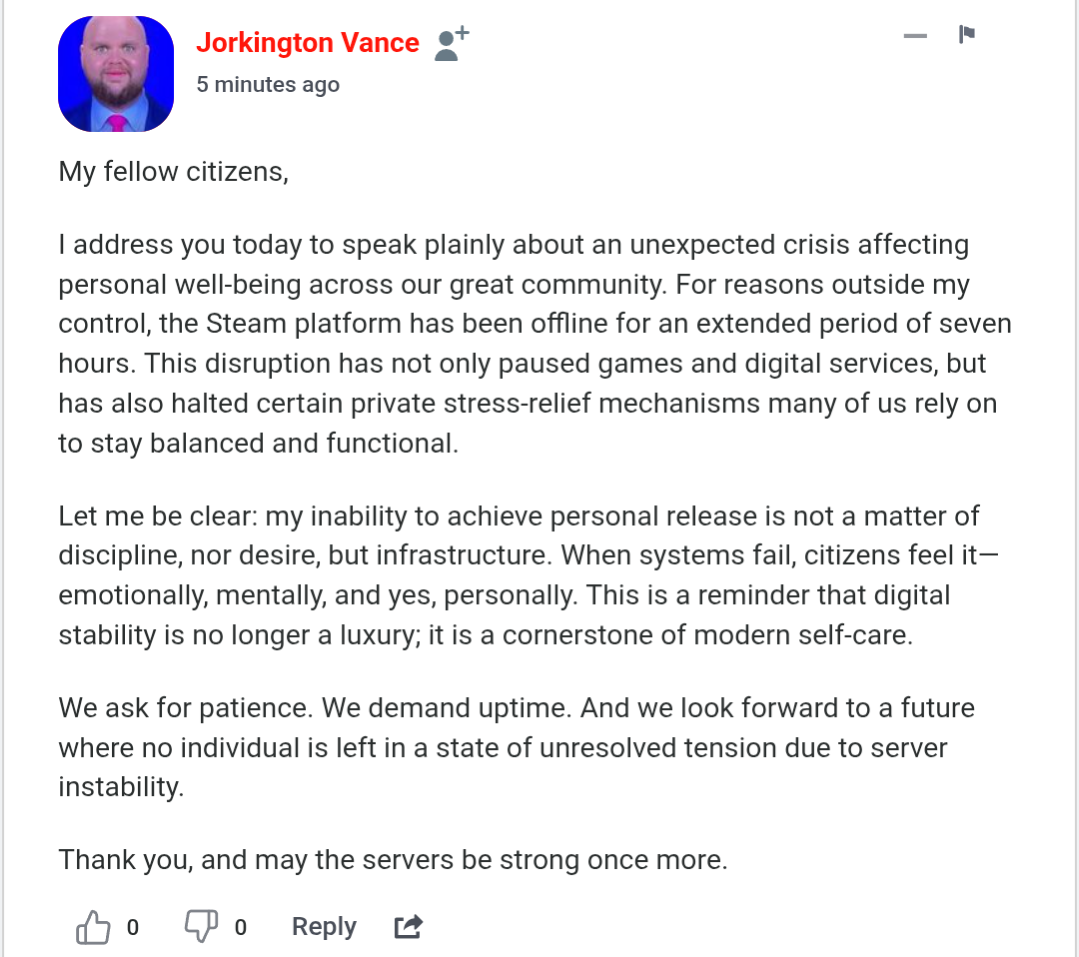
The downdetector comments have descended immediately into utter madness
Here, I found the video
It’s youtube because I couldn’t find it anywhere else. But I think it addresses some of your points. The biggest point it makes is that at the same time that the greater economy lost 3 million jobs (or had that many layoffs), the gig economy gained roughly the same number of people.
I saw a breakdown the other day postulating that the true unemployment rate is masked by the gig economy, because people are more likely to drive Uber than file for unemployment



Watch videos and read some articles about it. There are different edge angles for different use cases, but you’ll generally aim for 20-25°. For things like razors and kitchen knives you’ll want a straight grind/edge and for more heavy use knives a slightly beveled edge is okay. Low grit is for large corrections like burrs and blunt spots. Those kinds of corrections will take a lot of time and you’ll want to look for uniformity before moving to higher grits for a sharper edge and eventually polish. Highly recommend starting with an angle tool and going slowly with a knife you don’t really care about. Work on keeping your angle and pressure consistent and don’t press down very hard. If you apply too much pressure you’ll damage both the edge and stone, especially for softer (higher grit) stones. Check your work regularly to make sure the edge is consistent, you’ll see it pretty clearly under a light. It takes practice. I’ve been freehand sharpening for about 20 years and I still mess up sometimes.
My biggest tip is regular maintenance! I clean and do a few passes on 3000 grit with my kitchen knife every time I use it and it’s been my sharpest knife for 10 years. And clean your stone! Residual steel will build up, making the stone less effective and also risking damage to the edge.