

After some time playing with SDR I decided to finally get a decent dedicated shortwave radio.
In this image the Sangean ATS-909X2 is set to receive at 14.074 MHz in USB mode to capture some FT8 signals.
The phone is running the FT8CN app and it captures the audio to decode the messages via the microphone.
7.074 MHz and 28.074 MHz also work great for this.
Thanks a lot for your kind words and recommendations!
As for Morse code, actually yesterday I watched a video that blew my mind, this one: https://www.youtube.com/watch?v=GvQ_UnePS7w
It is so cool. Even if no longer necessary, the way this operator communicates over Morse code is fascinating and I would really like to be able to do that some day. So, if I do get a license I am for sure going to at least try to learn the bare minimum to identify myself and say hello with this nice gadget 😄
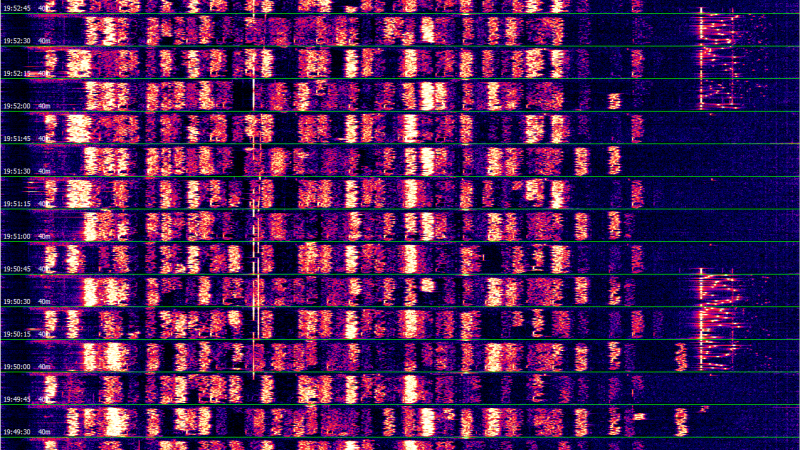
Morse code is amazing in its capacity to be intelligible much much farther under the same power as phone (voice) because the modulation requirements are orders of magnitude smaller than needed for phone; another way of looking at it is CW (“Morse”) requires far less power to be intelligible the same distance as phone. Phone bandwidths are 1500-3000hz where CW is like 100hz. I grabbed a screenie of an SDR during a worldwide amateur radio competition a few years ago which illustrates what I mean:
Each narrow streak on the left are CW operators making CQs (contacts), while on the right, the broad strokes are voice operators doing the same.
If you pursue learning Morse, I implore you use the CWops method which is not to use graphics, or other mnemonics commonly found on the internet. You don’t have to join CWops–just use their recommendation of listening and sending: https://morsecode.world/international/trainer/trainer.html. The reason here is that graphics and such will form a bottleneck in learning.
You’ve got me started on talking Amateur radio, so I mildly apologize. One of the absolute strengths of CW is being able to take a very small, compact transceiver (about the size of an adult hand) with limited power (10W) and a resonant length of wire backpacking, then string up the wire on a tree and make worldwide contacts. On 10W.
One of the greatest things about CW operators is that they will respond to your CQ or call at your speed, so even if you’re a very slow sender, most folks are quite patient to complete the CQ.
I was just now looking through a few resources to learn morse code so this is very helpful! It is fortunately simpler than I thought - I was under the impression that the code mapped to full words, not individual letters/numbers, and so that it was essentially a different language. Memorizing the alphabet seems relatively straight forward to me now, but it probably takes a lot of time and effort to become proficient. I’ll give it a try.
It is indeed magical when one considers the minimum resources needed to transmit and receive CW over long distances. Of course digital modes are quite efficient and accessible now, but I don’t think most people can turn millisecond arrays of 0’s and 1’s into actual words without the help of some fancy device.
It’s all super fascinating. There’s a plethora of digital modes, FT4, JT65, JT9, to name a few. Then there’s Slow-scan TV (SSTV) which is a lot of fun:
I can go on and on, really consider getting your license, I think you’d have a lot of fun!
Ooh, is that what SSTV should look like? I tried capturing some earlier today using Radio 36, but I could not get a good image. I even trying capturing the image directly from the audio of YouTube videos, and I could only get the silhouette of the image that way. I’ll keep trying.
Alright then, I’ll do it then… The exam will combine two challenges in one for me because I’ll have to take it in Dutch, and my Dutch is still not amazing, haha
Yes! This happens to be pretty good reception of an image, there are others which are not so great. Sometimes you have to tweak the settings, or make sure you’re using the correct decoding mode; there are quite a few of them. They have names like Martin and Scottie, among others.
If–and I hope you’ll forgive me for an assumption here–you have a US mailing address, you could get your US amateur licenses fairly quickly and then operate under CEPT (once you have General or Amateur Extra) within certain Dutch jurisdictions. You do not need to be a US citizen, or even live here. You can conduct your entire exam via online zoom call. I did my Tech (first license in the US) from a beach on a tropical island with adequate WiFi during the pandemic, and then I did General and Amateur Extra upgrades a couple of years later in a different part of the world, each only weeks apart, also via zoom.
In this way, you can gain some experience operating before taking your exams in Dutch. https://hamstudy.org/ and from there you can book exam appointments online. Here’s how wild my setup was: I was on a Pacific Island, taking my US exam, which was conducted by volunteers from the Volunteer Examiners of Australia, some of whom happened to be in the US. You’re joining a a true global community.
Alright, I think this is one that I should first practice with an SDR. I already identified the signal at 14,230 KHz, but maybe the phone is not capturing the audio from the device with the quality required. Or it might be the decoding. This will be easier to test with the computer.
Thanks for the tip, I wish I was a in tropical island at the moment. I don’t have a US mailing address, although I some in my family and family friends do. However, the system here appears to be quite streamlined - register online, show up to the test center, answer 40 multiple choice questions - I will do some practice tests with the relevant Dutch terminology and give a try. There is no penalty for failing (other than test cost) and no limit to how many attempts I can do. My partner also wants to get one so that she can also transmit, otherwise she’d see me having all the fun.
I tried a few different training methods and I am liking this one: https://stendec.io/morse/koch.html