After some time playing with SDR I decided to finally get a decent dedicated shortwave radio.
In this image the Sangean ATS-909X2 is set to receive at 14.074 MHz in USB mode to capture some FT8 signals.
The phone is running the FT8CN app and it captures the audio to decode the messages via the microphone.
7.074 MHz and 28.074 MHz also work great for this.
You must log in or # to comment.
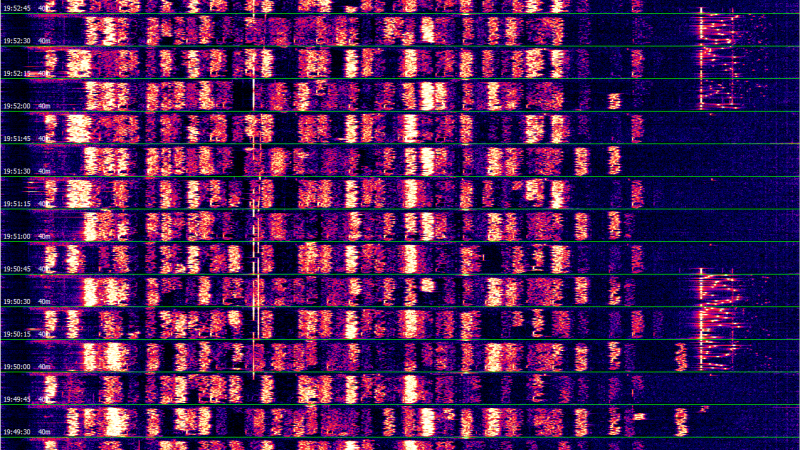
20m is usually pretty busy on FT8 as well: (FT8 on center, FT4 right)
Turned up my reading comprehension a little to notice you were on 20m.
I still haven’t memorized the wavelength mappings so I always think in frequency
When I first got my Tech, I was restricted mostly to 10m on HF, or ~28Mhz, so that was the first one I got down. Then I noticed each band deeper into HF was basically twice the wavelength (or half the frequency), so 20m is ~14Mhz, and 40m is ~7Mhz and so on. The exact placement within that band gets pulled up on an allocation chart, but that’s how I was able to wrap my head around it.
That’s a good method, it makes sense! I will remember these now: 3.5,7,14,28 = 80,40,20,10, and use them to anchor the others.
As I played with the radio I would compute 300,000 m/s / 40 m -> 30/4 is 7.5 so somewhere close to 7 MHz… But this method was a bit cumbersome so I have just been ignoring the wavelengh so far, hehe.
We all come to it in different ways.
Are you only an SWL (shortwave listener) or do you also have an amateur license?
I don’t have a license yet, or any SW transmitters. I have been thinking of maybe getting a license. I started playing with GSM/LTE modules, then LoRa, then got into identifying signals all over the place using SDR.
This past week I decided to buy a dedicated shortwave radio to see if it gives me something that the SDR doesn’t, and it actually does, it has different ergonomics and I find it a lot smoother for exploring the 100 KHz - 30 MHz region. With my SDR I think it is a bit cumbersome to explore this region as someone who doesn’t know what to look for. The radio is more constrained and set up to move through the spectrum in ways that make sense.
That’s a wonderful way to begin. To add to your tools, there’s also a free web SDR offered by a group of volunteers: https://www.sdrutah.org/. There’s also KiwiSDR: http://kiwisdr.com/public/. I’m partial to SDRUtah because they have really good labels and it’s easy to understand what one is looking at. LoRa is neat and I’ve also been interested in getting into Meshtastic.
I encourage you to pursue your license, most jurisdictions now do not require Morse code, so it’s never been easier. Welcome to the hobby!
Thanks a lot for your kind words and recommendations!
As for Morse code, actually yesterday I watched a video that blew my mind, this one: https://www.youtube.com/watch?v=GvQ_UnePS7w
It is so cool. Even if no longer necessary, the way this operator communicates over Morse code is fascinating and I would really like to be able to do that some day. So, if I do get a license I am for sure going to at least try to learn the bare minimum to identify myself and say hello with this nice gadget 😄