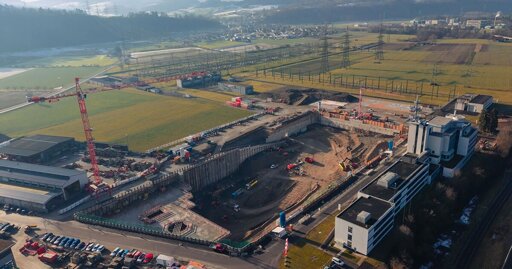
The giant battery will be fed with excess energy generated by windmills.
Nice.
This makes the life of the battery practically limitless.
Good.
Plus, it’s non-flammable, and almost completely recyclable at the end of its service life.
Great.
capacity of 2.1 GWh, which is estimated to be enough to supply 210,000 households with power for an entire day.
Amazing.
Beyond preventing outages, this one will also be tasked with meeting high demand from AI data centers in the area.
Fuck.
I don’t see why anyone would build a AI datacenter in this more populated area of the world, with all the regulations and restrictions in emissions.
It makes a lot of sense as 800MWh available within ms (especially directly linked to a major grid hub like it is the case here, Laufenburg is famous for it as it’s also the point where the swiss and German grids meet) is the wet dream of every grid planer that has to stabilize a network. That is around 12% of the whole average power draw of Switzerland. Which is impressive.
We need more of these.
“We will be able to inject or absorb up to 1.2 gigawatt-hours (GWh) of electricity in a few milliseconds,” FlexBase co-founder Marcel Aumer told Swiss public broadcaster RTS earlier this month.
Does this make sense? How the hell do you transfer that much energy in milliseconds? Especially with a battery that requires the flow of liquid?
This article is complete bullshit. What they probably meant is that it can switch between energy input and output within milliseconds, which is realistic. Whoever wrote this lacks a basic understanding of the technology.
From what I read, it does 800 MW max, which is still a lot.
1.2 GWh is just the capacity. And response time can indeed be quite fast as the system is always on standby, but I would guess it would still take a few seconds to go from zero to full power
But with 800 MW it takes an hour and a half to get to 1.2 GWh, and an hour is 3600 seconds or 3600000 ms. So “a few” is doing a lot of work in that quote.
its a kind of “no proove of concept” as it is build by the guys which heavily lobby mini atomic plants
There are various working redux flow large capacity batteries operating already (as mentioned in the article as well), e.g. Daillan, in Japan, this one is just a tad bit larger
UNLIMITED POWER
Just gotta make sure nobody falls in there.