Explanation: Austria-Hungary had a spiffy flag, if you like coats of arms.
It was also nowhere near a functioning polity, being predicated on the dynastic domination of a royal family over two large polities which, themselves, were barely functioning patchworks of other minority ethnicities given just the right amount of concessions and brutality to not revolt at any given moment. It was a very… medieval setup for a late 19th century polity. Not helping matters was a total inability to decide on even a lingua franca for government use - the Austro-Hungarian military itself (wherein one expects fast communication to be important) had chains of command that had to pass through several translators to get news up the pipeline. The OODA loop there was certainly not optimal.
k.u.k. stands for kaiserlich und königlich - ‘imperial and royal’ - as the Austro-Hungarian Empire was a union of the (imperial) Austrian throne and the (royal) Hungarian throne.


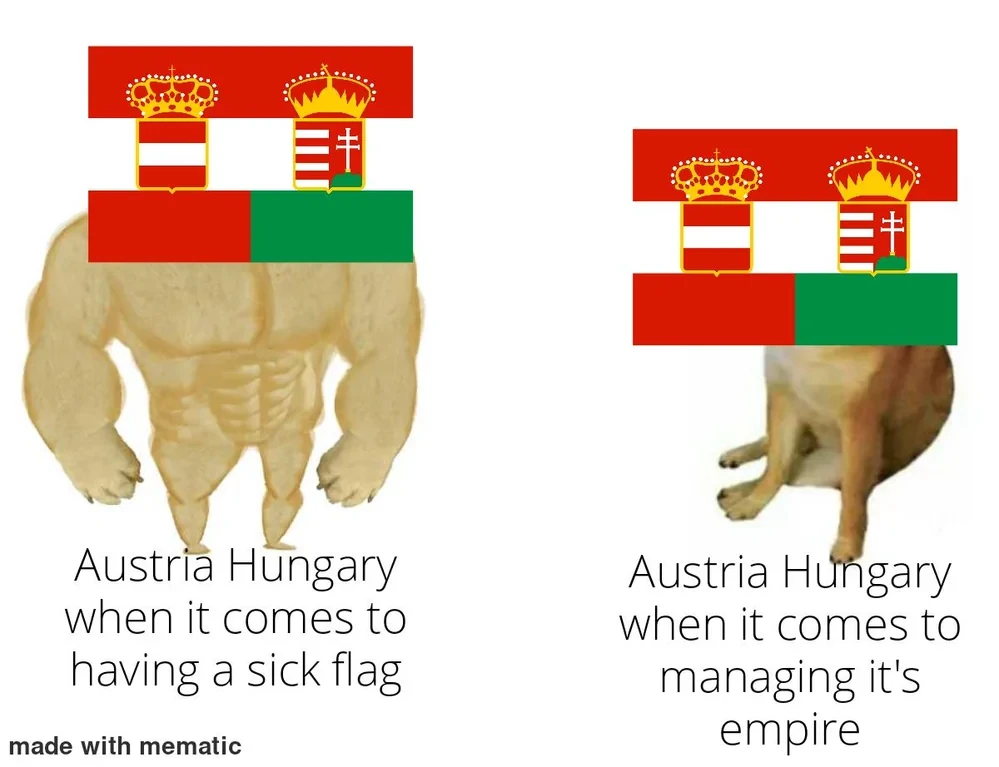
Explanation: Austria-Hungary had a spiffy flag, if you like coats of arms.
It was also nowhere near a functioning polity, being predicated on the dynastic domination of a royal family over two large polities which, themselves, were barely functioning patchworks of other minority ethnicities given just the right amount of concessions and brutality to not revolt at any given moment. It was a very… medieval setup for a late 19th century polity. Not helping matters was a total inability to decide on even a lingua franca for government use - the Austro-Hungarian military itself (wherein one expects fast communication to be important) had chains of command that had to pass through several translators to get news up the pipeline. The OODA loop there was certainly not optimal.
k.u.k. stands for kaiserlich und königlich - ‘imperial and royal’ - as the Austro-Hungarian Empire was a union of the (imperial) Austrian throne and the (royal) Hungarian throne.